Sunday, 14 October 2018

The Unexpected Power of Reading Conferences

https://www.edutopia.org/article/unexpected-power-reading-conferences

The Unexpected Power of Reading Conferences

A high school English teacher has a single accountability measure for her students’ choice reading: talking to them about it.
August 29, 2018
A teacher and a student conferencing together
©iStock/Steve Debenport
Teachers face many challenges when it comes to helping students develop a love of reading, some of which I wrote about in “Putting an End to Fake Reading,” but one of the most daunting is the accountability piece. How do we know if students are actually reading? How do we assess the learning students are gaining from choice reading? How do we include this in our grade books?
I’ve tried many accountability measures over the years, including reading logs of various formats, book reports, assorted handouts, and reading quizzes on Accelerated Reader, but Donalyn Miller’s The Book Whisperer and Penny Kittle’s Book Love helped me realize why those assessments were so unsatisfying. If I wanted my students to become authentic readers, why was I assigning them activities that real readers—including me—would never voluntarily engage in?
I had to ask myself: What do real readers do? And one important part of my own reading life is talking about what I read with others. So I decided to try an experiment and do away with all accountability measures for choice reading except for one-on-one conferences with me.
The results were profoundly positive.

THE LOGISTICS OF CONFERENCING

Although the idea of talking about books with students is appealing—honestly, it’s one of the main reasons I became an English teacher—the first thing I had to tackle were the logistics of the conferences.
In my on-level 10th grade English classes, I allot 10 to 15 minutes of our 55-minute periods for choice reading, and my students range widely in reading ability and motivation. I was worried that juggling everything going on in my classroom would be overwhelming, but with some structure and fine-tuning, I was able to have great discussions with two to three students each day, and to talk with each of my students at least once a month.
At the beginning of the period each day, I greet students and quickly take down the page number they’re on in their books. This serves several purposes. First, it’s a reminder for students to have their books out and open for reading right at the beginning of the period. Also, it gives me a quick way of assessing their progress through their book. If a student has read only a few pages over the course of the week, I know they’re probably in need of some help in either getting into their books or choosing a new one, and a conference is a perfect way to work out which it is and find a solution.
I then grab my reading conference binder and sit down in one of two chairs I’ve arranged in a comfy corner of my room, calling over a student to begin our chat. I’ve established norms for independent work in my classroom, so with occasional reminders, students know that this is a time to work quietly on their own.

KEEPING TRACK OF CONVERSATIONS

To keep track of conferences, I keep a binder with dividers for each class and a note sheet for each student where I record the details of our conversations for future reference.
I always start out by asking each student to remind me what they’re currently reading and what page they’re on, and I ask what rating they would give their book and why. This gives us a jumping-off point for what to talk about next. I also have some reading conference questions to refer to if I’m stuck for something to ask, but the more I conference with students, the easier it is to know what to talk about. I only need to remember my purpose for reading conferences: supporting students in thinking about their books and helping them find books they enjoy.

ASSESSING CHOICE READING

Real-life readers don’t get scored for reading for pleasure, but I do want to encourage students to find books they enjoy and to give them a way to keep track of their own reading progress, so I created a simple sheet for them to record the books they finish, along with their thoughts about what they read. When students finish a book, they complete this sheet and bring it to our conference, and we use it to talk about the book and what they might like to read next.
I don’t have a requirement for how many books students must finish, and these sheets are not scored in any way. I simply save them in the student’s class file for reflection at the end of the grading period. The only score my students receive for choice reading is this reading reflection each six weeks, in which they write their thoughts and feelings about the books they’ve read and what they’d like to read next. I give them completion points, not a grade, for doing the reflection.

THE RESULTS OF MY CHOICE READING EXPERIMENT

When I began this experiment, I was concerned that, without the accountability of points entered in the grade book, my students would not be motivated to read. My fear, however, was proven beautifully unfounded.
More of my students read far more books than ever before, and with our regular conversations, it’s far easier to notice and support students who are struggling with finding a book they enjoy. I’m able to tap into some student interests—sports fiction and poetry collections among them—and, most importantly, I’ve noticed my connections with students strengthening. And that’s probably the most important thing a teacher can do to improve learning in the classroom.

Sunday, 17 June 2018

Leadership Freak - Small Groups

LEADERSHIP SMALL GROUPS ARE KEY TO CULTURE CHANGE

20 complimentary copies available.
Leave a comment on this guest post by Art Barter to become eligible to win one of TWENTY complimentary copies of  “The Art of Servant Leadership II: How You Get Results Is More Important Than the Results Themselves.”
(Deadline: 5/19/2018)
*International winners will receive digital versions.
In my journey of transforming a corporate culture to one that is servant-led, I’ve learned the value of leadership small groups. The purpose of leadership small groups is to create a safe environment for leaders to discuss the challenges they are having in changing the culture.
In our company, Datron, anyone with a manager or above title is required to be part of a leadership small group. Groups are made up of 8 – 10 leaders and meet monthly for 1 hour. Through these groups, the culture change process is accelerated as trust is built within leadership teams.
Small group attendance at Datron has become a welcome part of our leaders’ responsibilities.
Tips for establishing small groups:
  1. Group members must understand whatever they hear or share is confidential. What’s shared in small group stays in small group. This provides a safe environment for leaders to share their struggles and successes in changing company culture.
  2. Do not require an agenda and or any reporting to upper management. Encourage people to seek advice from each other and share their stories. Leaders will gain solutions to problems and build stronger relationships between each other and their departments.
  3. The group should be made up of peers. You can’t be in the same small group as the person you report to.
One unexpected outcome of our small groups was with on-boarding new leaders. We found it’s a great way to introduce new leaders to their peers and help them learn about your culture and where the company is headed.
Your organization will be stronger when relationships are built through the leadership small group format. Culture change will take hold in your leadership team and your organization will be better because of it.
What suggestions do you have for establishing or running leadership small groups?

Leadership Freak - Make the most of Difficult Feedback

3 WAYS TO MAKE THE MOST OF DIFFICULT FEEDBACK

20 complimentary copies available.
Leave a comment on this guest post by Alex Vorobieff to become eligible to win one of TWENTY complimentary copies of  “Transform Your Company: Escape Frustration, Align Your Business, and Get Your Life Back.”
(Deadline: 6/9/2018)
*International winners will receive digital versions.
Don’t be afraid of feedback.
Five minutes into my first talk to a group of CEOs,  one pushed his chair back, tilted his head back and let out a silent groan. I wasn’t connecting and he was letting me know.
I prepared for weeks. I accepted the feedback and resolved to improve my speaking skills, but I still had 35 minutes to go.
Not all negative feedback is given directly. When you can harness it, you can stop wasting your time and other people’s time. There are three steps to using feedback effectively.
#1 Recognize absence of feedback is negative feedback.
The easiest feedback to give is none.
The giver doesn’t have to risk hurting your feelings, getting you mad or having to defend their feedback. At the end of my CEO talk, there were a couple of questions. They avoided me after the presentation. Nobody offered any feedback.
#2 Give permission for honest feedback.
The next day I called one of the CEOs in the audience and asked for feedback.
He asked was I ready for it and I gave him permission to not hold back. Some of it hurt. He said my talk was indulgent,  vague and verbose. It was painful to hear. It was difficult to not interject.
#3 Just Receive the feedback.
It is hard enough to give negative feedback, so just accept it.
One person’s perspective is not the only perspective and you can get multiple sources. Look for the common threads. They  are telling you something that will help you achieve what you want faster.
The next day, I started the long journey to improve as a speaker.
Two years later, I got a request from the same group to speak. The silent groaner was there. This time his head stayed level and he was engaged throughout. The negative feedback improved my skills.
How might leaders successfully seek feedback?

Leadership Freak - Pop the Cork on Stress

ONE STRATEGY TO POP THE CORK ON STRESS

It’s great to have someone show interest in you.
A friend, Richard Croad from New Zealand, just asked about highlights I have experienced over the last couple years.
Lot’s of highlights come to mind. Visiting Ireland and London, talking with some of the smartest leadership experts in the world, and traveling with my wife all come to mind.
The most satisfying experience is a shift in approach that’s evolved over the years.
I’m not sure when it happened, but I show up differently than I did in the past.
Leadership Freak blog is a little over eight years old. I’ve been traveling and speaking for about seven years. My concerns have changed in a way that cause greater satisfaction.
Worry more about liking people and less about being liked.
I show up to like people. In the past I showed up worrying if people liked me. Now, when I meet people at speaking engagements, I find something to like about them.
It feels good to forget – at least a little – about myself and appreciate others. Not long ago, I visited a client just to let them know I liked them. It felt great.
Showing up to like people pops the cork on the pressure to be liked. It’s joyful and freeing.
  1. Notice something good about everyone you meet.
  2. A focus on faults and weaknesses feels like dislike.
  3. When you correct, confront, coach, or instruct, do it with with a forward-facing approach. Turn people toward what they could do. That feels like you like them.
  4. When someone volunteers a bit of personal information, honor it. They aren’t sharing so you can outdo them.
  5. People tend to like you when you like them.
If Richard asked you for one of your highlights over the past few years, what would you say?

Leadership Freak - Strategies for Dealing with Defensive people

STRATEGIES FOR DEALING WITH DEFENSIVE EMPLOYEES

Feedback is wasted on Mr. Defensive. He closes his mind to anything that feels threatening. 
The chronically defensive can’t benefit from helpful suggestions or constructive feedback.
Strategies of Mr. Defensive:
The moment you bring up an uncomfortable issue, Mr. Defensive:
  1. Has a reason or excuse why things didn’t work out.
  2. Casts blame. It’s always someone else’s fault. Mr. Defensive can’t take responsibility.
  3. Explains all the good things he’s done. Mr. Defensive is awesome, even though things aren’t going well. 
  4. Tells a long story that keeps them in control of the conversation. You can’t get a word in edgewise when Mr. Defensive begins story time.
  5. Accuses others of being worse than he is. He might have screwed up but he’s not as bad as someone else.
Don’t get defensive when someone gets defensive. Practice kind candor.
Kind candor clarifies confusion as long as it turns toward the future.
Strategies for dealing with defensive employees:
  1. Evasiveness: Say, “I’d like to circle back to my original topic.”
  2. Avoidance: Say, “I’m having trouble connecting what you just said with the issue I mentioned. What relationship do you see between the original topic (name it) and what you said in response?”
  3. Avoidance: Say, “I thought you were responsible for this project. Am I mistaken?”
  4. Blame: Say, “I don’t want to talk about someone who isn’t in the room. Could we discuss your role in this issue?”
Notice don’t judge.
I noticed when I brought up this issue you turned the conversation to something else. I’d like to circle back to my original topic.
Deal directly with defensiveness:
Mr. Defensive loves it when you dance around issues.
Seek to understand.
Say, “I notice that you started talking about someone else when I brought up this issue. What’s going on for YOU right now?”
Short-term pain beats long-term drain.
How might leaders deal with defensive employees?

Leadership Freak - Why Humility Delivers More

https://leadershipfreak.blog/2018/06/15/why-humility-delivers-more-results-than-arrogance/

WHY HUMILITY DELIVERS MORE RESULTS THAN ARROGANCE

Arrogance holds you back. Humility propels you forward.

Courage and humility:
You’d be wrong if you said humility is kin to fear.
Courage is the willingness and ability to fail and try again.
Arrogance needs to appear perfect so it plays it safe. It won’t try unless success is certain. Arrogance fears and rejects failure.
Humility accepts responsible failure and keeps going.
Wisdom and humility:
The arrogant become fools.
Arrogance learns slowly, if at all. It won’t accept advice or guidance from others because it believes it already knows best. 
Learning is hard for arrogance.
Arrogance knows. Humility knows there’s more to know.
Humility learns from failure, improves, and gains insight. Arrogance, on the other hand, repeats ineffective behaviors and blames others for failure.
Humility learns because it listens. Arrogance despises listening.
Arrogance points fingers.
Humility takes responsibility and grows.
There is no growth apart from taking responsibility.
Humility and results:
Humility respects and appreciates others. Teams work hard for leaders who appreciate their hard work.
Humility connects with others and honors their talent.
Arrogance stands aloof and feels threatened when others shine.
Five practices of humility:
  1. Learning.
  2. Listening.
  3. Courage.
  4. Connection.
  5. Responsibility.
Which of the five practices of humility are most relevant to you?
How are courage, learning, and results connected to humility?

Monday, 12 March 2018

What Ed Said - What Do Inquiry Teachers Believe?

WHAT DO INQUIRY TEACHERS BELIEVE?

1. What is your ‘image of the child’? 
How do you view the learners in your class? Do you believe children are inherently intelligent, curious and creative? Do you recognise their rights and their capabilities? Do you trust them to learn?
2. What do you believe about learning? 
Knowing what and how to teach is not enough. Have you, individually and as a school, thought deeply about how you believe learning takes place? Have you carefully examined the extent to which your practice aligns with your beliefs?
3. Who do you believe should hold the power? 
Is your token nod to agency allowing the learners a choice when you decide it’s the time? How much of what your students say and do has to be channeled through the teacher? Do you make most of the decisions? Or do you believe the learners can really lead the learning? Is initiative valued over compliance?
4. Do you see every learner as an individual? 
Are you tempted to refer to the class as ‘they‘ or do you always consider each individual’s personal story? Are you aware of what influences each student’s  learning? Are your beliefs evident in your language, your expectations, the routines in your room and in the relationships you build?
5. Do your learners believe in themselves? 
Do you group your learners on perceived ability or do they have opportunities to learn with and from others with varying strengths, challenges and interests? Is a growth mindset fostered? Are learners motivated by learning itself, rather than extrinsic rewards that encourage winners and losers in the game of school?
6. Who do you believe should do the heavy lifting?  
Do you explain everything in detail, sometimes several times in different ways? Or do the learners have a go at experimenting and tackling problems first and you step in at point of need? Are you able to release control so that the heavy lifting is done by the learners?
7. Who owns the curriculum? 
Do you have secret teacher business? Do you always decide what to cover and how to teach it? Or do you believe that students can be empowered to explore curriculum requirements via their own inquiries, in their own ways?
8. How important is measurement of achievement?
Do you teach to the test? Do you believe everything has to be formally assessed and what can’t be measured is less valuable? Or is the process of learning perceived as more significant than the outcome? Is process valued over product?
9. What is the language of your classroom? 
Do you talk about work and tasks or does everyone speak the language of learning? Is how we learn as much a part of the conversation as what we learn? Are students aware of who they are as learners? Are learning dispositions noticed and named? Do you and your students believe that reflection and metacognition are integral parts of learning?
10. Is there a safe space for risk-taking and failure? 
Does the learning culture encourage students to take risks and make mistakes? Do learners seek and grapple with challenging problems and unanswerable questions? Do you (and they) believe that failure is an opportunity to learn and grow?
If you’ve thought about your ‘why’, the ‘how’ is much easier to achieve.  Are you asking the right question?
* Influenced by the Modern Learners podcast The Answer to How is Yes. Now reading the book by Peter Block.

Monday, 5 February 2018

What Can We Learn From a School Where Teachers Don't Teach

This week Independent Thinking founder Ian Gilbert had the opportunity to visit a very interesting school within a school in the Netherlands and took away some interesting lessons for educators everywhere.
Agora is a school within Nikée School in Roermond in the south east of the country. They regularly host visitors from across the world who are keen to learn more about their approach to learning. And it all about ‘learning’ and not ‘education’ as our host for the visit, coach (‘don’t call me a teacher’) @robhouben was at points to point out.
The driving force behind the school’s set up is that the traditional education-driven school model makes children learn things they don’t want to learn in a way that doesn’t suit them at a time that isn’t right for them and is a ridiculous process shored up by a regime of energy-sapping behaviour systems, time-consuming classroom management and testing regime that has the same effect as taking the carrot out of the ground every few days to see how well it is growing[*].
What the educators behind Agora did was to rip up the rule book about what education is all about and focus instead on the innate power children have to learn combined with the fact that responsibility and control, like respect and hugging, are things you get by giving. In Agora, children choose their own challenges and then set about achieving them inside and outside of the school environment (a remarkable student-designed environment in itself — see pic) with the support of — but not the teaching by — their coaches, qualified teachers embracing the Agora way.
On our visit, children were happy, eloquent (in Dutch and English) and motivated, loving the freedoms and real-world challenges of the Agora model and glad to be away from the ‘boring turn to page 10 and copy’ processes they had experienced elsewhere.
While there may well be no middle ground between a conventional school intent on hanging onto its traditional education-driven structures and a school like Agora, what is interesting are the ‘Seven Habits’ they say underpin this model, habits that we believe any educator can learn from, regardless of their setting:
1. Own you own development and growth
You’re in charge of your life, not us. Want us to teach you? We won’t. Want us to tell you what to do? We won’t. Want us to make sure you succeed? We won’t. So, what do you want and what are you going to do about it?
2. Discover and orientate
What is out there? What does the world have to offer and what does the world need? That’s where your challenge lies. Think beyond what you already know. What do you need in order to succeed and who and what can help you?
3. Connect
You’re never more alone than when you’re in an exam. But learning doesn’t have to be that way. Identify and develop the web of connections you need to be part of to achieve your goals.
4. Communicate
The better you are at communicating the more successful you will be. But remember, it’s a two-way street. What will you give in return when you reach out to the busy world beyond school?
5. Reflect
How can you be better in the future — what worked and what didn’t? And how can we better — what helped you and what didn’t? And what did we all learn from the experience?
6. Share
While the challenges you set yourself are yours, that does not mean you are working on your own. By sharing your learning you can benefit from the wisdom, skills and knowledge of others — young and old — as well as help them with their goals.
7. Research
What worked? What did you do, where did you go and who did you turn to in order to help you achieve what you have achieved? What sources did you cover, uncover or discover? What have you learned about learning?
This, of course, is a very quick overview of a fascinating school and we look forward to sharing more in due course. In the meantime, please do hook up with @robhouben if you want to learn more or maybe visit for yourself.
No-one, let alone Agora, is saying you have to do it like they are doing it. But what schools like this prove is, as we at Independent Thinking keep saying, there is always another way. (ITL)
Ian Gilbert founded Independent Thinking nearly 25 years ago and has lived and worked in the UK, the Middle East, South America and the Far East. He is currently based in The Netherlands.

Tuesday, 30 January 2018

Caring and Compassionate

Caring and Compassionate Confrontation https://usergeneratededucation.wordpress.com/2018/01/21/caring-and-compassionate-confrontation/ When I was in my Doctoral program, I met in one of my classes Debbie who was the Corporate Education coordinator for the university. She ran workshops for teams from profit and non-profit organizations and corporations. I had mentioned that I had a background in adventure education with a focus using outdoor team building activities. She got excited and said that the university does team building on their off campus site and asked me to join her as a facilitator. At the time I was a chain smoker, about 2 packs a day, and had been smoking like that for about 10 years. These activities were outdoors so I would smoke during these day long team building days. We would have the clients fill out evaluation forms at the end of the day and use these evaluations to do our end-of-day debriefings. During one such debriefing, Debbie had found several comments about how my smoking disturbed several of the individual clients. She looked at me with such a caring look and said, “You are so good at what you do. It’s such a shame that your smoking detracts from that.” On the way home that evening I threw away my cigarettes and never smoked again. This ended up being a peak experience in my life in that Debbie’s unconditional caring facilitated major behavioral change in me. compassion-desmond-tutu Fast forward to present day . . . this is about a 5th grade student in one of my gifted education classes. Last semester, J. was incredibly annoying. He got on both my and his classmates nerves way too often. He was a “know-it-all” with both the other students and me. He was loud, often claimed he knew the answer (he often did), and when he was correct, he would exclaim loudly, “I told you so.” When we had competitions such as with board games and Kahoot, he often won and would gloat. I had lots of one-on-one talks with him telling him that I believe that he is smart and insightful, but that he often alienates others (including me) with his comments. I emphasized that I wanted others to see his talents but with his comments and attitudes, others would not see them. I also told him that winning competitions does feel good but that he should congratulate himself silently as not to get his peers angry. We’ve been back from break for several weeks (I meet with them twice a week for a few hours each time). I noticed that he is not so loud, doesn’t make such antagonist comments, and lets me help him with technology-based assignments. On several occasions, I told him that I noticed his changes and that I am proud of him. When asked, he said he made a New Year’s resolution to make changes. Last semester I didn’t think he was listening to my suggestions, but he was! The following excerpts from the Harvard School of Education’s The Troublemakers (http://www.gse.harvard.edu/news/ed/18/01/troublemakers) support the idea of caring and compassionate confrontation. We teachers all have our Joes, our students who consistently call out, talk back, refuse to participate or sit down or stay on task. They throw our lessons into disarray, make our heads pound. They keep us up at night strategizing, worrying. How can I connect? What strategies might work tomorrow? How do we reach and teach our troublemakers? Most teachers have binders brimming with ideas: shuffled seat assignments, tracking systems, rewards for on-point behavior. But when these fail, what can you do when it’s you alone in your class balancing 29 personalities, the clock ticking and your 40-minute-long class is almost up? Some strategies for working with these kinds of difficult students include: Seek out our students’ strengths. All students have strengths. Perhaps they are avid photographers, basketball players, coders, or poets when not in school. But when it comes to our troublemakers, it can be easy for their assets to be overshadowed by behaviors that disrupt the carefully cultivated cultures of our classrooms. We cannot lose sight of these strengths. Yet it is not enough to know that our troublemakers are budding artists, scientists, and entrepreneurs. We must also seek to reframe and better understand the qualities we find most frustrating. Strategize with students. We can only guess as to why a student might call out or fail to do homework. Rather than assume we know the answer, ask. From our students we can better learn what hurdles they face and in what ways we can support their success. And in doing this we demonstrate our commitment to our students. Create opportunities for students to realize their potential and be publically recognized for their academic achievements. All students are capable of achieving remarkable things, they just might need our help to do so. In raising the stakes, but also the support, we can create opportunities for students to explore at the edge of their capabilities. And when they do succeed, celebrate these achievements. Our troublemakers are too often only publicly acknowledged for their disruptions. We can change this pattern by intentionally creating opportunities to publicly recognize their strengths.

Monday, 11 December 2017

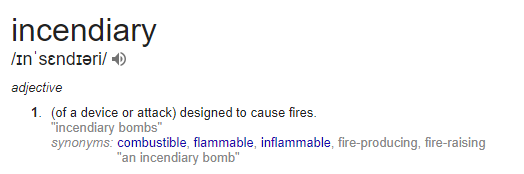
Incendiary Learning


Incendiary Learning


We’ve always stated that meaningful learning is flammable. It starts with a spark and then ignites! You know when learning has caught fire….. agency ensues and the student drives their learning and not too much gets in their way. The difference between a flame and incendiary learning can be categorized quite easily in terms of duration, desire and determination.
A flame burns during a specific period of time (unit of inquiry) and usually reduces to embers, just like a typical fire. The student wasempowered and energized, yet there was a point that they moved on to the next thing.
Incendiary learning catches fire and stays burning bright, long after a unit of inquiry. The student is empowered and energized, and they are still in the fire taking their learning even further, long after the next thing.
A stark contrast. One is perishable and one is enduring.
The subtle difference between ‘was‘ and ‘is‘ has a remarkable difference at the same time. This changes the whole complexion of learning as the ‘energy of learning’ has been sustained and has the learner enthralled.
Last week, I visited a previous School I was at and a number of the students I taught literally, hunted me down. One of those students was Nicole.
This is Nicole as a Grade 5 student articulating to the Head of School (Adrian Watts) the message she is trying to communicate through her art piece. Her art work is an incredibly personal and powerful piece as she is expressing the importance of finding her voice and expressing who she is. The mouth in the background are all those who have told her that she can’t do anything. With Nicole at the center of her art work, her positive is radiating out and drowning out the negative and judgmental voices. This was a real turning point for Nicole in developing her self believe. She had a teacher who saw something special, and it was all about allowing her to see that too. This was step 1 in Nicole’s journey of finding herself.
The next learning experience pushed her even further. Enter the Exhibition. Nicole’s artwork was the first step she needed to take and this naturally led her to explore and better understand her next self-discovery…. putting her new transformative experience of who she is becoming into action and finding direction in the process!
This is Nicole during the Exhibition selling her ‘FABTAB’ (comes in different sizes and colours) at a market at Saigon Outcast. This is the moment that shaped her to be a confident and articulate communicator as she interacted with dozens and dozens of people interested in her entrepreneurial idea. Incendiary Learning! Students, parents, teachers and customers where truly astonished!
As I mentioned above, I saw Nicole last week. We got talking and she said that she just made her first International order to Ireland of 100 FabTabs…..  Nicole is still producing, refining and taking orders, now International orders, for her FabTab. What a journey she has been on and is still very much on. It all started from her artwork, that was the first step she took in believing in herself, because she had someone who believed in her.  We must believe in all of our students. Personalize learning, individualize learning, whatever form it takes or looks like, choose the right approach at the right time to connect, develop and strengthen their identity of who they are. Work from that point, work from within! Let students determine their own identity and not the other way around! It is our role to play a hand in nurturing and nudging them in positive ways to see their own potential.
This is exactly what I mean by Incendiary Learning! The fire is still burning bright and Nicole has stretched in ways where she can confidently talk about the learning experience….. long after the ‘unit.’ Nicole has led her learning and is proud of what she has achieved. Agency…… yeah, true Agency at its very core! This is Nicole now in Grade 7 doing a photo shot for this very piece. The relationship and connection seems just like yesterday, still very much alive too!
Again and again…. keep our eye on the ball!
https://timespaceeducation.wordpress.com/